
The Photo Op Politics of Legislator Sam Gonzalez

The most honest moment of Sam Gonzalez’s political career may have lasted less than three seconds.
As Governor Kathy Hochul signed new immigration-related protections into law last week, immigrant families and children stood around her carrying the real weight of the moment. They were there because they have lived through the fear that has settled over immigrant communities since the return of Trump-era immigration enforcement: the raids, the sightings, the rumors, the panic every time an unfamiliar SUV slows down on a neighborhood block.
Then, from the right side of the room, Suffolk County Legislator Sam Gonzalez rushed into the frame just as the cameras started clicking.
And suddenly the entire story of his politics was sitting in one photograph.
To outsiders, it may have looked harmless. Another elected official attending another ceremonial bill signing. But for the people in Brentwood who have spent the last year organizing frightened residents, documenting ICE activity, and begging local officials to act, the image landed differently. It looked opportunistic. It looked desperate. It looked like a man trying to inherit the moral credibility of a movement he refused to stand beside when it actually mattered.
Because when immigrant families in Brentwood needed leadership, Sam Gonzalez was nowhere to be found.
Since the beginning of the second Trump Administration, Islip Forward has documented immigration enforcement activity across Long Island through the Long Island ICE Tracker. Brentwood has consistently been at the center of that reporting. Families began checking for ICE sightings before driving to work. Parents worried about routine errands. Entire neighborhoods lived with the kind of low-grade fear that slowly changes how people move through their own community.
Throughout that period, Islip Forward repeatedly attempted to engage Gonzalez about the growing crisis unfolding in the district he represents.
The response was silence.
On June 23, 2025, Islip Forward held its first major in-person rally on Suffolk Avenue in Brentwood. Hundreds of residents came out demanding accountability as immigration enforcement activity intensified across the area. Gonzalez refused to attend.
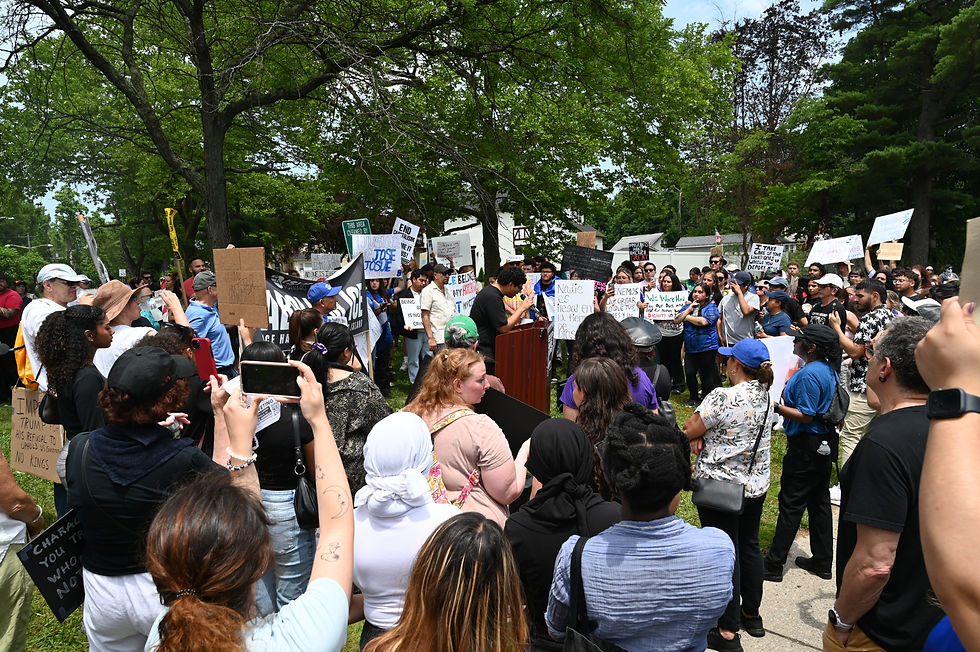
Days later, ICE was seen outside a Brentwood Fire Department substation. Community members sounded the alarm because the implications were disturbing: a public-facing institution trusted by residents appeared connected, directly or indirectly, to federal immigration enforcement activity unfolding in the heart of Brentwood.
Islip Forward contacted Gonzalez and his staff seeking clarity and leadership. Instead of responding with urgency, Gonzalez questioned whether the agents were ICE at all. Then he doubled down. On his radio show, he publicly defended the fire department and dismissed demands for accountability by shrugging the issue off as a “federal matter” supposedly beyond the reach of local officials.

Local politicians suddenly discover the limits of their authority only when taking a stand becomes politically inconvenient. The same officials who hold press conferences on national issues, issue public statements on federal policy, and flood social media with outrage somehow become powerless spectators the moment immigrant families in Brentwood ask them to act.
What residents wanted was not complicated. They wanted Gonzalez to stand with the community demanding answers. They wanted him to pressure local institutions. They wanted him to acknowledge the fear spreading through the neighborhoods he was elected to represent.
Instead, he chose skepticism toward residents and sympathy toward institutions.
That instinct — protecting systems while doubting communities — has defined his posture ever since.
The pattern deepened after a July 14 submission to the Long Island ICE Tracker showed armed agents in military-style fatigues moving through Islip Town streets. That report helped expose the Town of Islip’s ongoing contract allowing ICE to train at the town’s municipal shooting range.
This was no longer abstract. Local infrastructure was actively supporting the same enforcement apparatus generating fear throughout immigrant communities across Long Island.
When advocates demanded an end to the contract, Gonzalez publicly declined to join the effort.

That moment stripped away the remaining excuses. Because this was not about caution or restraint. It was about political convenience. Again and again, Gonzalez found reasons not to act, not to speak, and not to challenge local complicity while immigrant families absorbed the consequences.
By 2026, the disconnect between Gonzalez’s public image and his actual record had become impossible to ignore.
When he was confronted alongside Senator Monica Martinez over his inaction at a public event in March, his staff choked out a constituent. Days later, members of Gonzalez’s circle appeared on their radio show laughing about the incident.

That moment revealed something deeper than arrogance. It exposed contempt.
Contempt for the residents demanding accountability. Contempt for the organizers documenting what was happening in their communities. Contempt for the idea that immigrant families deserved more than staged sympathy and empty rhetoric.
Which is precisely why Gonzalez’s appearance beside Governor Hochul felt so offensive to so many people in Brentwood.
Immigrant justice is not a costume you put on for a press conference. It is not a backdrop for political branding. It is not something an elected official ignores locally and celebrates ceremonially once Albany cameras arrive.
If Gonzalez wanted to stand beside immigrant families at that bill signing, he should have stood beside them on Suffolk Avenue. He should have stood beside them when ICE was reported outside a Brentwood firehouse. He should have stood beside them when residents demanded an end to Islip’s ICE training contract.
Instead, he stood aside until there was a photograph to jump into.
That is the real story behind the image. Sam Gonzalez wants the optics of solidarity without the political risk solidarity requires. He wants proximity to immigrant families without accountability to them. He wants the applause that comes from the movement without ever standing with the people who built it.
But Brentwood knows the difference between leadership and performance.
And no photo-op can erase the record.
Comments